
Reusing a Destiny Matrix image can save work, but its caption belongs to a particular question. A crop that suits a discussion of the center may remove information needed for a channel comparison. A correct sentence attached to the wrong image can still mislead the reader.
This guide follows an invented publication plan using one illustrative chart in two contexts. Its completed check record catches a crop/text mismatch and tracks the repaired version through export. All image versions and publication situations described here are hypothetical; no external publication or reader test is reported.
Write a separate image brief for each question
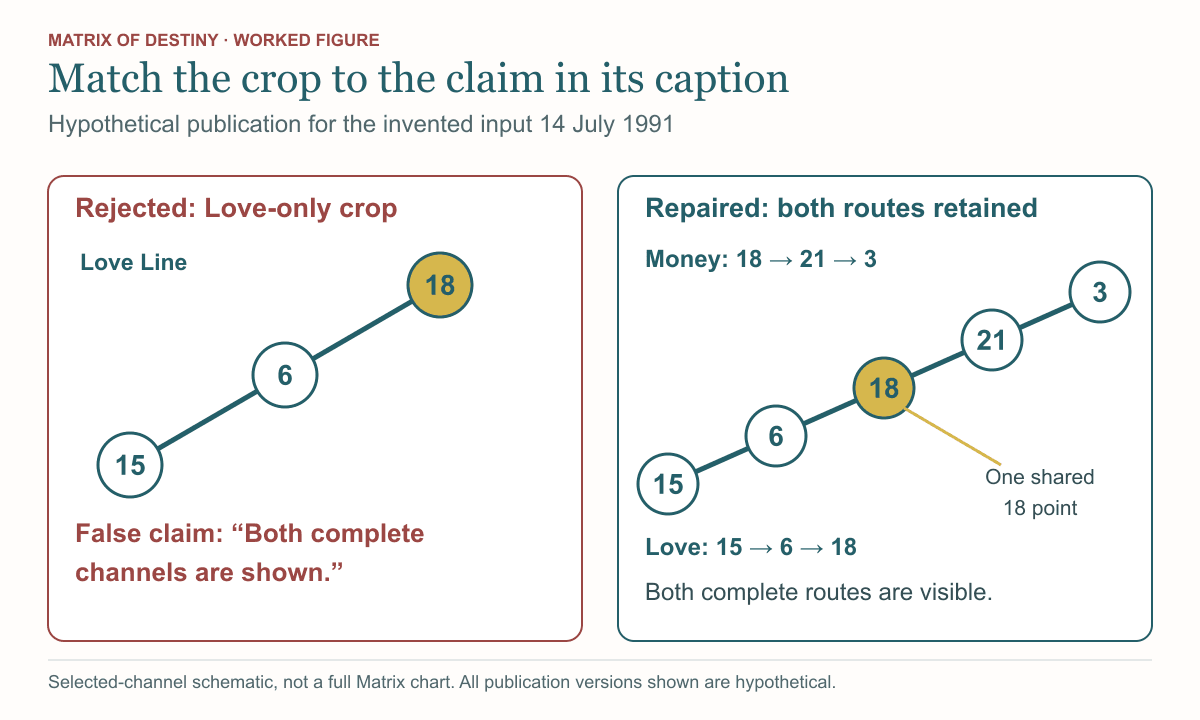
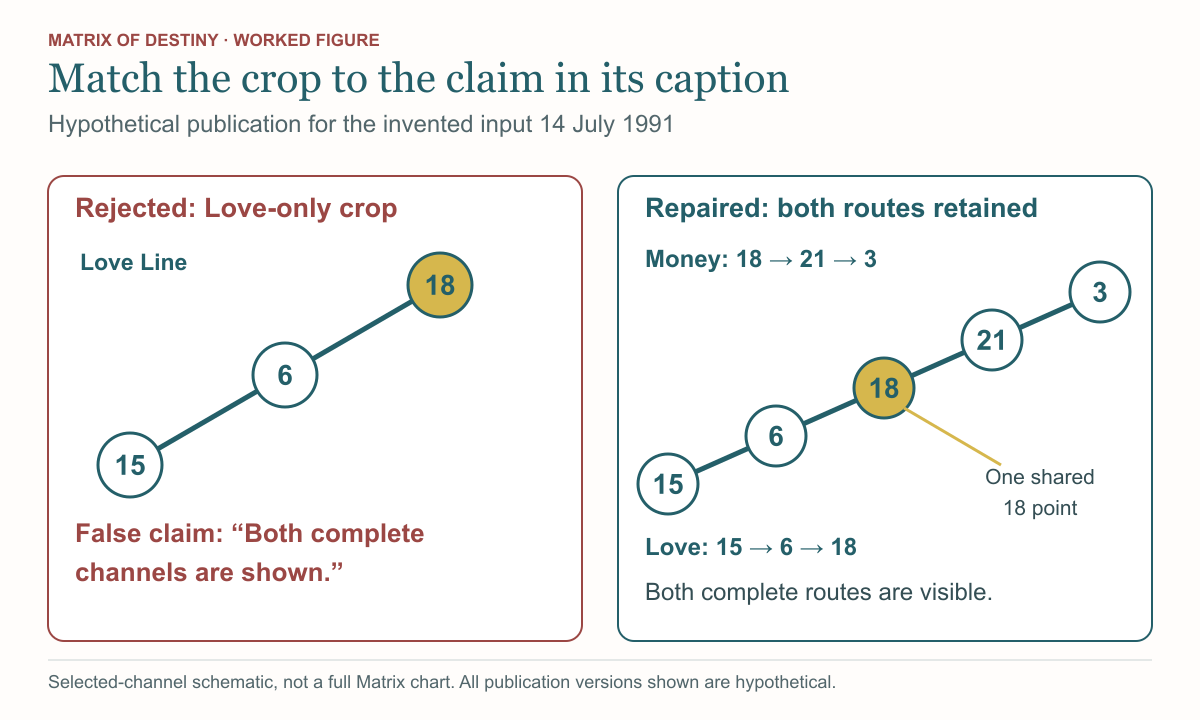
Use the invented birthday 14 July 1991. The engine gives center E = 10, Heart Arcana 6, Love Line 15 → 6 → 18, and Money Line 18 → 21 → 3. These values stay fixed across the two briefs below. The selection of information changes.
Context A is a teaching handout about distinguishing the center from the heart. Context B is a page about the crossover shared by the Love and Money Lines. Copying the whole caption from A to B would preserve true values while failing to explain B's question. Copying only an attractive crop can create the same problem visually.
| Context and question | Information the image must retain | Caption focus |
|---|---|---|
| A: Are center and heart the same position? | Center 10 and heart 6, with enough location context to distinguish them | Two different named positions |
| B: Where do the Love and Money Lines meet? | Both ordered channels and their single shared crossover 18 | Two routes sharing one physical point |
Catch the claim that the crop no longer supports
In the invented first draft for B, the editor crops tightly around the Love Line 15 → 6 → 18. The crop removes the Money Line's 21 and 3 points. Its copied caption nevertheless says: ‘Both complete channels are shown, meeting at 18.’ The numbers may be correct in the original chart, but ‘both complete channels are shown’ is false of this crop.
The editor marks the mismatch before export. Merely adding more detail to the caption would not make the removed branch visible. Because B's purpose is to compare the two routes, the chosen repair is to widen the crop until both routes and their meeting point remain legible. If that is impossible in the available space, the publication needs a different illustration or a narrower claim.
The same check applies after a platform automatically crops an uploaded image. A source file containing every point is insufficient if the reader's final view omits the branch that the caption asks them to inspect.
Pair each final image with its own text and source
The editor keeps a small record for the two hypothetical outputs. The version labels below are example asset names, not downloads supplied by this article. Their purpose is to prevent an older crop from being paired with the revised caption.
| Output and asset version | Final caption | Check against the final image |
|---|---|---|
| A · center-heart-v1 | Illustrative personal chart: center 10 and Heart Arcana 6 are different positions. | Both named points remain visible; no complete-channel claim |
| B · crossover-v2 | Love Line 15 → 6 → 18 and Money Line 18 → 21 → 3 share the single crossover 18. | Both complete routes are visible; crossover is one point |
| Shared source record | Invented input: 14 July 1991; this site's calculation convention | Values checked against the same fixture for both outputs |
Mark the rejected crossover-v1 crop as superseded in the working record. Keeping it in a folder without a clear status makes a later accidental reuse easier.
Inspect the publication after the last transformation
Open the exported handout or final page, then compare its image, visible caption and accompanying description with the record. Check that rescaling has not made a route label unreadable and that a text location such as ‘details below’ still points to a real heading. A preview seen before the final crop is not the final check.
W3C's Web Accessibility Initiative complex-image guidance distinguishes a short identification from a fuller text account of essential image information. The text-chart guide covers that description task. Here the additional check is consistency: does the description belong to this image version, this selected scope and this publication context? A matching caption alone does not establish accessibility conformance.
For context B, inspect the reading order in the text as well as the drawn routes. Naming the crossover at the end of Love and start of Money does not mean there are two different circles with that value. The final explanation should preserve that shared-point relationship.
Recheck the whole pairing when any part changes
Record the input, calculation convention, source heading and date checked alongside the image version. If a later correction changes a value, inspect every publication that reused the image rather than replacing only the sentence where you noticed the error. If the input stays fixed but the article's question changes, revisit the image brief and crop anyway.
The closing line of the illustrative record is: ‘A uses center-heart-v1 with the two-position caption. B uses crossover-v2 with the two-channel caption. Both refer to the same checked illustrative fixture; the earlier B crop is superseded.’ That is a publication consistency record, not evidence of a real release or of the symbolic interpretations.
- Write the question for each destination separately.
- List the positions and relationships each image must retain.
- Compare the actual crop with every claim in its caption.
- Record the approved image/text pairing and its calculation source.
- Inspect the final exported or published version and repeat the check after revisions.
Image, caption and publication consistency record
Use the fields below to make your own record. The downloadable text copy is editable and can be used without an account.
- Publication destination and reader's question:
- Required positions and relationships:
- Illustrative input and calculation convention:
- Source heading and date checked:
- Image filename or asset version:
- Caption version paired with it:
- Actual crop and claims compared:
- Mismatch and selected repair:
- Older pairing marked superseded:
- Final export or page checked:
- Publications to revisit after a correction:
Method, sources, and editorial approach
- Natalia Ladini: publisher author profile and book list (Russian). Reference for the method's author and published works.
- Yuliana Lisovskaya, Matrix of Destiny: Compatibility, chapter two (Russian reading preview). Reference for the core construction and staged reduction used here.
- W3C Web Accessibility Initiative, Images Tutorial: Complex Images; general guidance on text descriptions, consulted November 5, 2026
- Matrix of Destiny: chart positions and calculation reference
- Original editorial two-context briefs, hypothetical crop mismatch and completed publication consistency record
This site’s calculation reference documents its numerical construction. Where this guide includes worked Matrix values, they come from the same engine as the full chart. Exercises and reflection questions are original editorial suggestions, not quotations from these sources; their usefulness is not established by the calculations. The method references document a spiritual practice. Listing a source does not establish scientific support for the interpretations or imply endorsement of this website.
This guide was drafted with AI assistance to explain the topic and organize examples. It is published by Matrix of Destiny, owned by Ana Kalender. No independent practitioner review is claimed. See our editorial approach and corrections policy.