
A chart may look balanced because two inputs begin with equal values. That is an arithmetic relationship, not a measure of inner balance or relationship harmony. The useful question is which equalities follow from the formulas and which parts remain different.
Our invented birthday is 8 August 2002. A and B both equal 8. The shared engine supplies the comparison below; the example is not an assessment of a person.
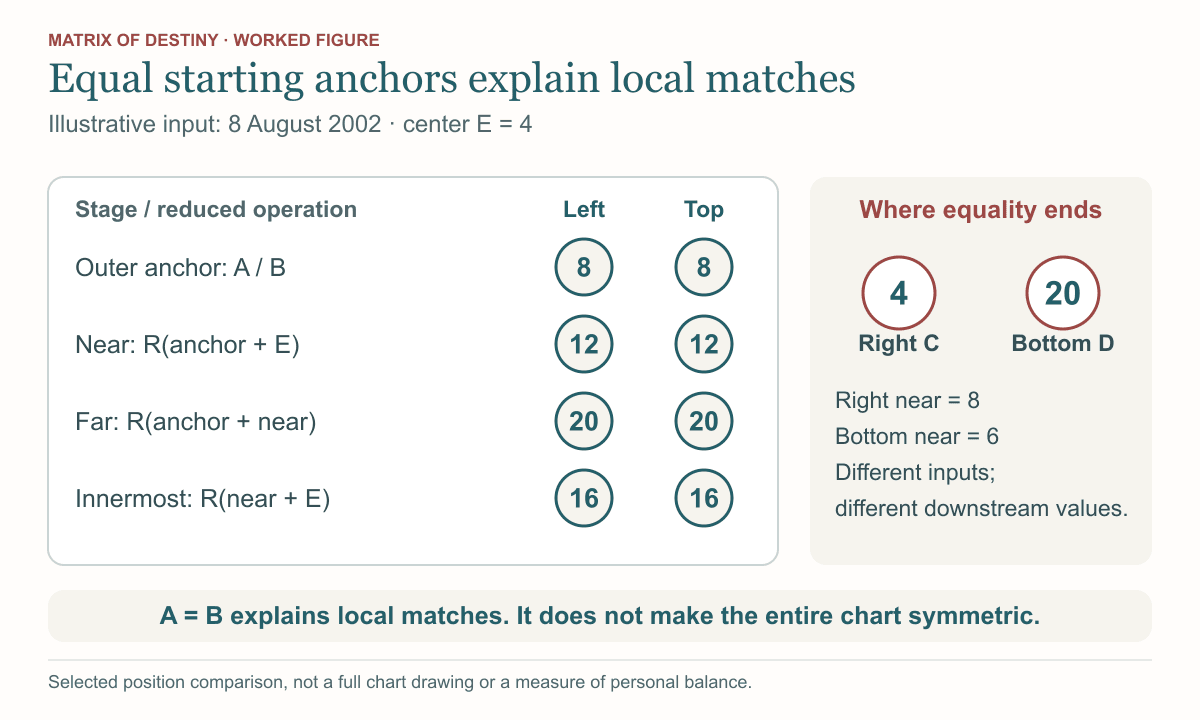
Follow equal inputs through equal operations
The top near-center value is R(B + E), while the left equivalent is R(A + E). If A equals B, their results agree. Their next stages also agree because each adds the same original anchor to the same near-center result.
This establishes a local relationship between the top and left axes. You do not need to invent separate meanings to explain why the same numeral appears there.
| Stage | Left | Top |
|---|---|---|
| Outer anchor | 8 | 8 |
| Near center | 12 | 12 |
| Near outer anchor | 20 | 20 |
| Innermost | 16 | 16 |
Look for the boundary of the symmetry
C is 4 while D is 20, so the right and bottom axes do not inherit the same equality. Their near-center values are 8 and 6. Equal A and B therefore do not prove that the entire diagram is symmetric.
A similar boundary appears in the chakra table: the first four Physics and Energy cells use the matching left and top constructions, and the center row uses E in both columns. The lower rows introduce C and D, which differ here.
Separate numerical symmetry from the drawing
The chart layout places many positions at matching geometric distances regardless of their values. A geometrically balanced star can contain unequal numbers. Conversely, two equal values may occupy locations that do not face each other.
In an illustrative annotation exercise, a learner colors only the four proven top/left pairs, then leaves the lower-right region uncolored. The annotation communicates a limited formula relationship rather than making the whole diagram appear supported by the same proof.
Make a local symmetry annotation
Choose the exact equality you think you see. If two positions are equal in one example but use different operands, treat that as a coincidence until a broader reason is shown. Equal outputs alone do not establish equivalent formulas.
- Record the starting input equality.
- Trace one pair of formulas with equal operands.
- Mark only the downstream positions that inherit the equality.
- Find a nearby pair where the operands differ.
- Caption the result as local numerical symmetry, without a personality conclusion.
A repeated number can have a structural explanation and still serve as an optional symbolic prompt. The explanation does not validate the prompt.
Local symmetry annotation
Use the fields below to make your own record. The downloadable text copy is editable and can be used without an account.
- Illustrative input:
- Starting equality:
- Paired formulas:
- Downstream equal positions:
- Boundary or counterexample:
- Drawing symmetry distinguished from values:
- Caption limited to the demonstrated relationship:
Method, sources, and editorial approach
- Natalia Ladini: publisher author profile and book list (Russian). Reference for the method's author and published works.
- Yuliana Lisovskaya, Matrix of Destiny: Compatibility, chapter two (Russian reading preview). Reference for the core construction and staged reduction used here.
- Matrix of Destiny production calculation engine; fixed illustrative inputs and exhaustive calendar experiment, checked November 5, 2026
This site’s calculation reference documents its numerical construction. Where this guide includes worked Matrix values, they come from the same engine as the full chart. Exercises and reflection questions are original editorial suggestions, not quotations from these sources; their usefulness is not established by the calculations. The method references document a spiritual practice. Listing a source does not establish scientific support for the interpretations or imply endorsement of this website.
This guide was drafted with AI assistance to explain the topic and organize examples. It is published by Matrix of Destiny, owned by Ana Kalender. No independent practitioner review is claimed. See our editorial approach and corrections policy.