
A reduction can preserve each individual sum while making its grouping matter. We tested both parenthesizations of every ordered triple a,b,c where each value runs from 1 through 22.
This is an arithmetic experiment on the site's reduceToArcanum helper. The values are operands, not birthdays or three people. The experiment does not introduce a new group-compatibility formula.
Define the operation precisely
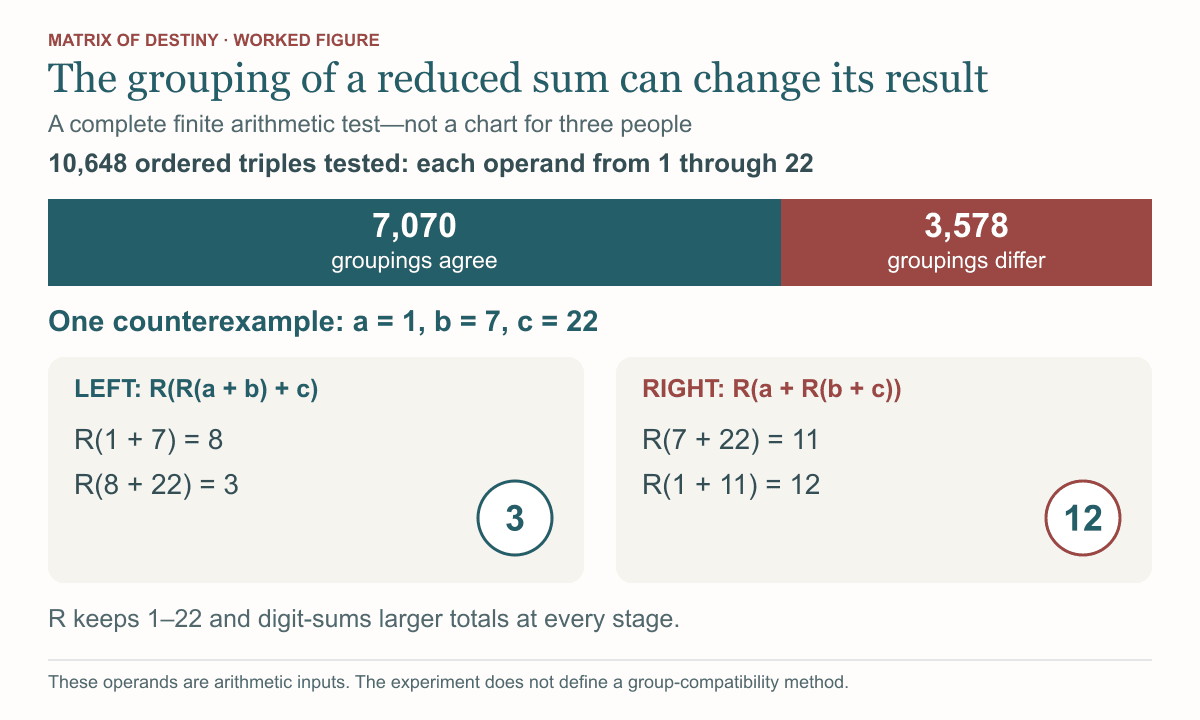
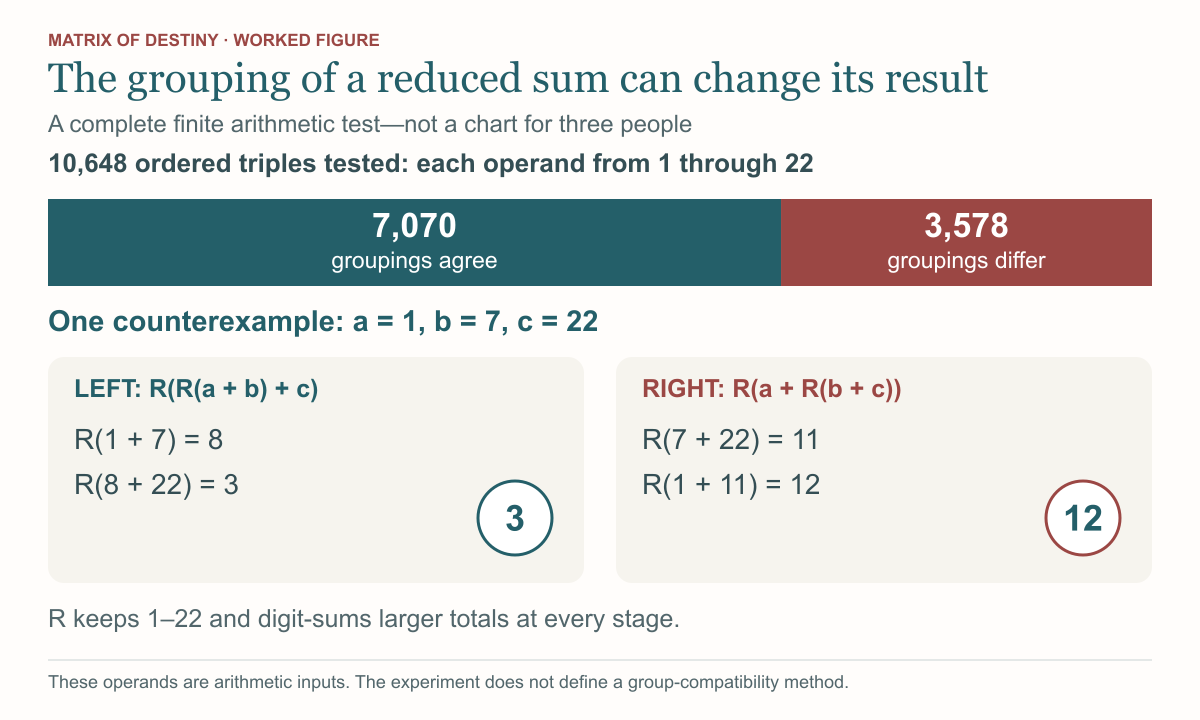
Let R keep values 1–22 and digit-sum larger totals. Compare left=R(R(a+b)+c) with right=R(a+R(b+c)). Each inner reduction must finish before its result enters the outer sum.
The helper also maps zero to 22, but zero is outside this experiment's chosen operands. Changing the operand domain changes the experiment. Do not silently include negative values, fractions or a different reduction rule.
Work through a small counterexample
Take a=1,b=7,c=22. The left route combines 1+7=8, then 8+22=30→3. The right route combines 7+22=29→11, then 1+11=12. Both routes follow the same reduction rule and give different results.
A control such as 1,2,3 agrees: both routes return 6. One agreeing example therefore cannot establish that regrouping is always safe, just as one disagreement does not mean every triple differs.
| a,b,c | Left route | Right route | Equal? |
|---|---|---|---|
| 1,7,22 | 3 | 12 | No |
| 1,2,3 | 6 | 6 | Yes |
| 14,10,10 | 16 | 7 | No |
Count the entire defined domain
There are 22×22×22=10,648 ordered triples. The two routes disagree for 3,578 and agree for 7,070. Ordered means that 1,7,22 and 22,7,1 are separate entries; the tally is not a count of unordered three-number sets.
The repository's enumerateGrouping function runs these three loops against the production reduction helper. This finite result supports the grouping claim on the stated domain. It does not tell you how often any particular chart formula would encounter those triples.
Apply the result to a proposed shortcut
When simplifying a chart calculation, preserve the original parentheses and compare the exact operations. An algebraic-looking rewrite can change the method because R is an extra operation between additions.
In an illustrative checking exercise, a learner records both the original nested expression and a proposed shortcut, finds a counterexample and retains the original. The useful outcome is a reasoned rejection of that shortcut, not a new symbolic meaning for 3 or 12.
- Write the original expression with all reductions visible.
- Write the proposed rewrite separately.
- Define the permitted input values.
- Test a control and a counterexample, then enumerate if the domain is finite.
- Keep the documented construction unless equivalence has actually been established.
The separate group-compatibility guide explains why this issue matters when people try to extend a two-person operation to three people.
Inspect the complete results and reproduce the experiment
The downloads include every chart-class count, the center totals and grouping totals for the stated scope. The reproduction bundles the same calculation engine used by this site; no private repository access, package installation or account is required.
To reproduce the results, save the .mjs file and run node destiny-matrix-lab-reproduction.mjs with Node 18 or later. It prints the complete result JSON. The version manifest records the source files and SHA-256 file checksums. These resources reproduce arithmetic, not birth frequencies, personality claims or predictions.
Download complete center counts, all 5,544 chart-class counts and grouping results (.json)
Download the complete runnable reproduction, including the calculation engine (.mjs)
Third-party license included with the reproduction (.txt)
Download the method version, source and file SHA-256 checksums (.json)
Reduction equivalence experiment
Use the fields below to make your own record. The downloadable text copy is editable and can be used without an account.
- Original expression:
- Proposed rewrite:
- Reduction convention:
- Operand domain:
- Agreeing control:
- Counterexample:
- Enumeration total and disagreements:
- Conclusion limited to the tested claim:
Method, sources, and editorial approach
- Natalia Ladini: publisher author profile and book list (Russian). Reference for the method's author and published works.
- Yuliana Lisovskaya, Matrix of Destiny: Compatibility, chapter two (Russian reading preview). Reference for the core construction and staged reduction used here.
- Matrix of Destiny production calculation engine; fixed illustrative inputs and exhaustive calendar experiment, checked November 5, 2026
This site’s calculation reference documents its numerical construction. Where this guide includes worked Matrix values, they come from the same engine as the full chart. Exercises and reflection questions are original editorial suggestions, not quotations from these sources; their usefulness is not established by the calculations. The method references document a spiritual practice. Listing a source does not establish scientific support for the interpretations or imply endorsement of this website.
This guide was drafted with AI assistance to explain the topic and organize examples. It is published by Matrix of Destiny, owned by Ana Kalender. No independent practitioner review is claimed. See our editorial approach and corrections policy.