
A system with 22 arcanum labels does not necessarily produce every label at every position. We calculated the personal center for every valid calendar date from 1 January 1900 through 31 December 2025 using this site's engine.
The experiment contains 46,021 dates, each counted once. It contains no birth records. Its frequency table describes the selected calendar interval and formula, not the proportion of people with a center or the probability that an interpretation is true.
Define the experiment before counting
For each year in the inclusive interval, enumerate its valid months and days. Pass each date to the shared calculateMatrix function and increment the count for E. Invalid dates such as 31 April are excluded before calculation. The full interval uses complete past years so its end does not move every day.
E is the reduced sum of A, B, C and the already-reduced D. A general list of arcanum meanings does not override that construction. Other schools or other positions need their own experiment.
Read the observed center counts
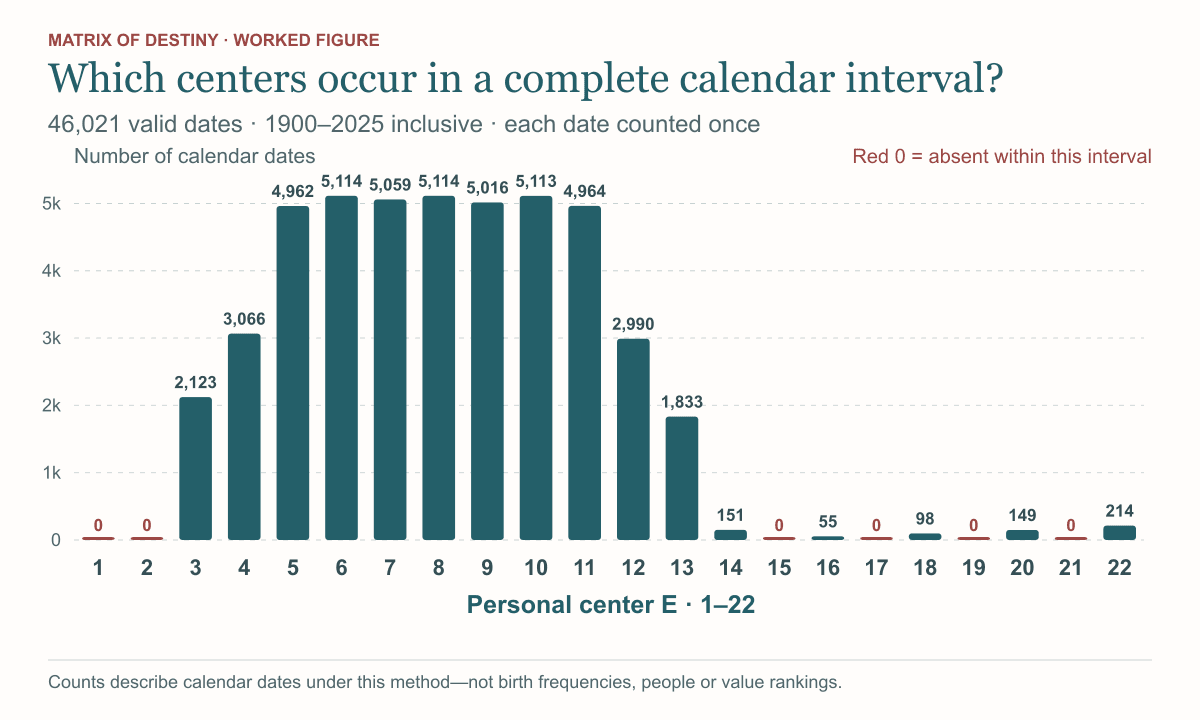
Six labels do not appear as E in this interval: 1, 2, 15, 17, 19 and 21. That is an observed result under the stated scope. It is not a statement that these labels can never appear elsewhere in a chart.
A center count must not become a ranking. A value with fewer dates is neither more developed nor more valuable than a frequent value.
| Center | Number of dates |
|---|---|
| 3 | 2123 |
| 4 | 3066 |
| 5 | 4962 |
| 6 | 5114 |
| 7 | 5059 |
| 8 | 5114 |
| 9 | 5016 |
| 10 | 5113 |
| 11 | 4964 |
| 12 | 2990 |
| 13 | 1833 |
| 14 | 151 |
| 16 | 55 |
| 18 | 98 |
| 20 | 149 |
| 22 | 214 |
Calendar frequency is not birth frequency
Each date receives equal weight here. Actual births are not distributed equally over years, months, days or locations. The experiment therefore cannot estimate how many living people have center 16, even though exactly 55 dates in the chosen interval produce it.
It also does not count unique complete charts: many dates share anchors, while two different charts may have the same center. The separate equivalence experiment answers that different counting question.
Reproduce a bounded result
For a small manual check, choose one complete month in a past year, list its valid dates and tally E from the calculator. For the full experiment, the repository function enumerateCalendar in the English expansion lab examples performs the stated loop and is checked against the published counts.
If changing the range, retain both the old and new scope. A new count is not a correction unless the earlier count was wrong for its own interval.
- Write the inclusive date range and engine convention.
- Enumerate valid dates, counting each exactly once.
- Count E separately from other positions.
- Confirm the sum of all center counts equals the number of dates.
- Report absent labels only within the experiment's scope.
The arithmetic establishes which results occurred. It does not establish a spiritual explanation for their frequency.
Inspect the complete results and reproduce the experiment
The downloads include every chart-class count, the center totals and grouping totals for the stated scope. The reproduction bundles the same calculation engine used by this site; no private repository access, package installation or account is required.
To reproduce the results, save the .mjs file and run node destiny-matrix-lab-reproduction.mjs with Node 18 or later. It prints the complete result JSON. The version manifest records the source files and SHA-256 file checksums. These resources reproduce arithmetic, not birth frequencies, personality claims or predictions.
Download complete center counts, all 5,544 chart-class counts and grouping results (.json)
Download the complete runnable reproduction, including the calculation engine (.mjs)
Third-party license included with the reproduction (.txt)
Download the method version, source and file SHA-256 checksums (.json)
Calendar reachability experiment
Use the fields below to make your own record. The downloadable text copy is editable and can be used without an account.
- Inclusive interval:
- Engine/method identified:
- Valid-date total:
- Position counted:
- Counts by observed value:
- Checksum: sum of counts:
- Absent labels within this scope:
- What these counts do not measure:
Method, sources, and editorial approach
- Natalia Ladini: publisher author profile and book list (Russian). Reference for the method's author and published works.
- Yuliana Lisovskaya, Matrix of Destiny: Compatibility, chapter two (Russian reading preview). Reference for the core construction and staged reduction used here.
- Matrix of Destiny production calculation engine; fixed illustrative inputs and exhaustive calendar experiment, checked November 5, 2026
This site’s calculation reference documents its numerical construction. Where this guide includes worked Matrix values, they come from the same engine as the full chart. Exercises and reflection questions are original editorial suggestions, not quotations from these sources; their usefulness is not established by the calculations. The method references document a spiritual practice. Listing a source does not establish scientific support for the interpretations or imply endorsement of this website.
This guide was drafted with AI assistance to explain the topic and organize examples. It is published by Matrix of Destiny, owned by Ana Kalender. No independent practitioner review is claimed. See our editorial approach and corrections policy.